House Deposit Savings Spreadsheet
Track an Australian home deposit in Excel with monthly savings, a dated one-off contribution, deposit milestones and an optional purchase deadline. Free download.
Turn a property-price target into a savings plan you can inspect month by month. This house deposit savings spreadsheet keeps current savings, future contributions and a purchase deadline separate, so a promised contribution is not mistaken for money already saved. Download the Excel file without an account or email address.
Free XLSX. No signup or email required.
Reviewed and maintained by the Calcy team · 17 October 2026 · General information, not personal financial advice.
Inside the workbook
- Dashboard
- Savings Inputs
- Monthly Savings Tracker
- Milestones
- Charts
- Instructions
XLSX for Excel. Editable inputs, protected formulas, no macros or external data connections. Save a personal copy before editing.
A tracker for the deposit, before the purchase budget
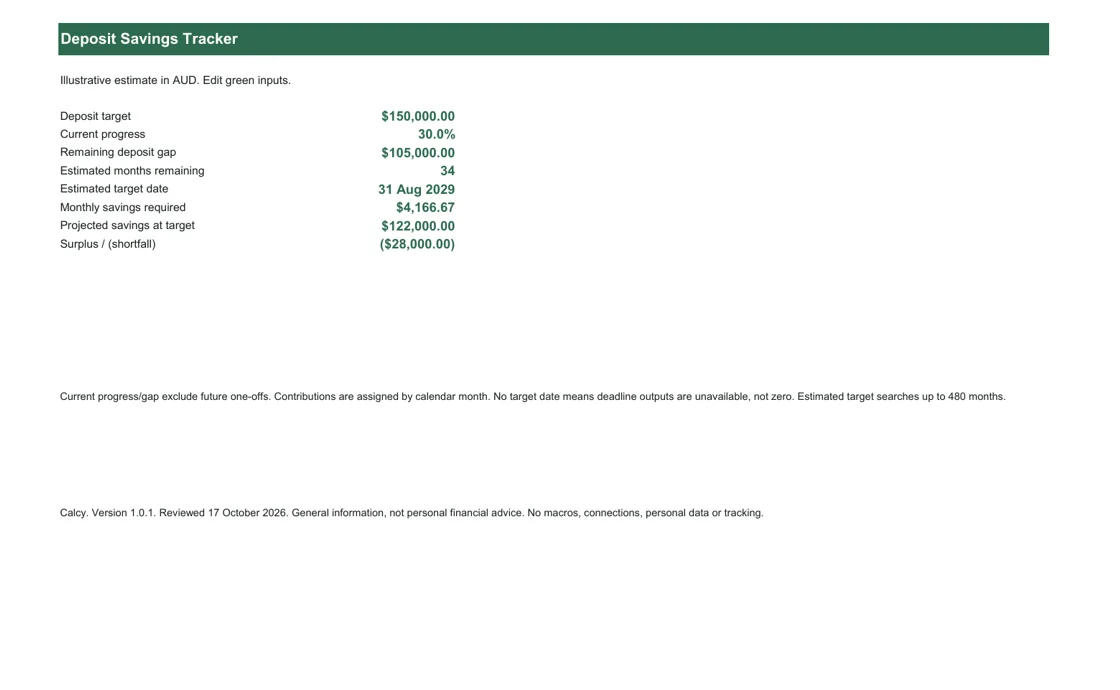
The Dashboard shows the deposit target, current progress, remaining gap, estimated months and target date. With a purchase deadline entered, it also shows the monthly contribution required, projected savings and surplus or shortfall. Milestones make 5%, 10%, 20% and your custom percentage visible without treating any percentage as a loan-approval test.
Use this alongside the First Home Buyer Budget Planner. The deposit is only one part of cash needed to buy: duty, inspections, legal work and a buffer belong in the separate buying-cost budget. This tracker neither estimates grants nor decides whether a lender or government program would accept your circumstances.
Worked example: saving towards $150,000
A clearly illustrative $750,000 property and 20% target produce a $150,000 deposit goal. Starting with $45,000 means current progress is 30% and the remaining gap is $105,000. With $3,000 saved monthly and a $5,000 one-off contribution in January 2027, the fixed October 2026 start reaches the target in model month 34, August 2029.
For an October 2028 deadline, there are 24 calendar months available. Projected savings are $122,000, leaving a $28,000 shortfall. Reaching that deadline would require approximately $4,166.67 monthly after allowing for the dated $5,000 contribution. These figures assume every planned contribution occurs; they are not a forecast of property prices or investment returns.
Dates and contributions have explicit rules
Regular savings arrive at month end. A one-off contribution is allocated to its calendar month; a contribution in the planning start month is immediately available for projection. Current progress still uses current savings only. A future one-off is not included in progress simply because you entered it.
The optional target date can be blank. In that case, deadline-dependent results say No target date while the estimated savings path still works. A target in a past or current calendar month is invalid: clear it or choose a future month. The calculation uses month differences, not a daily cash ledger, and supports up to 480 months.
Methodology, boundaries and practical use
Review the tracker each month against your actual bank balance. Update current savings and move the planning start date together when beginning a fresh plan; leaving the old balance beside a new start date can misstate the remaining journey. Keep a separate emergency reserve outside the deposit amount.
The target is price multiplied by the entered deposit percentage. The current gap is the greater of zero and target less current savings. Each projected closing balance adds regular and applicable one-off contributions to opening savings. Required monthly savings subtract any one-off due by the deadline from the gap and divide by months available.
Already-funded goals show zero months remaining. Zero monthly savings can leave the target beyond the model horizon; they do not produce a false arrival date. Negative amounts, text in required numeric fields, zero property price and a deposit percentage above 100% make outputs unavailable. The model assumes no savings interest, inflation, tax or property growth. Save your own copy and update assumptions as circumstances change.
Check the method and compare online
General context: ASIC Moneysmart: saving for a house deposit. Calculations use the methodology and assumptions explained above.
Optional email updates
Get new Calcy tools and home-buying updates
Free calculators, spreadsheets and practical Australian home-buying resources. Unsubscribe anytime. Confirm your address by email before receiving updates. Downloading never signs you up.
Frequently asked questions
Can I leave the target purchase date blank?
Yes. The savings path and estimated target date remain available. Deadline-based outputs display No target date.
Does a 5% milestone mean I qualify for a loan or scheme?
No. The milestones are arithmetic savings targets. Lender approval and government-program eligibility require separate assessment.
Can I include a one-off contribution?
Yes. Enter its amount and date. Future contributions enter the projection in their calendar month and are not counted as current savings.
Does the tracker include buying costs or savings interest?
No. It models deposit contributions without interest or price growth. Use the Budget Planner for other purchase costs.
General information and estimates, not personal financial advice. Check assumptions and official sources before making decisions.