Offset Account Spreadsheet
Free illustrative offset account spreadsheet for Australia. Compare monthly interest, loan balances and payoff timing with an offset balance and contributions.
See how a linked offset balance could change the interest-bearing part of your home loan. This free Excel workbook compares a no-offset baseline with an illustrative 100% offset scenario, with a visible monthly projection and editable inputs. No signup is required.
Free XLSX. No signup or email required.
Reviewed and maintained by the Calcy team · 17 October 2026 · General information, not personal financial advice.
Inside the workbook
- Dashboard
- Mortgage Inputs
- Offset Inputs
- Monthly Projection
- Comparison
- Charts
- Instructions
XLSX for Excel. Editable inputs, protected formulas, no macros or external data connections. Save a personal copy before editing.
What the offset workbook shows
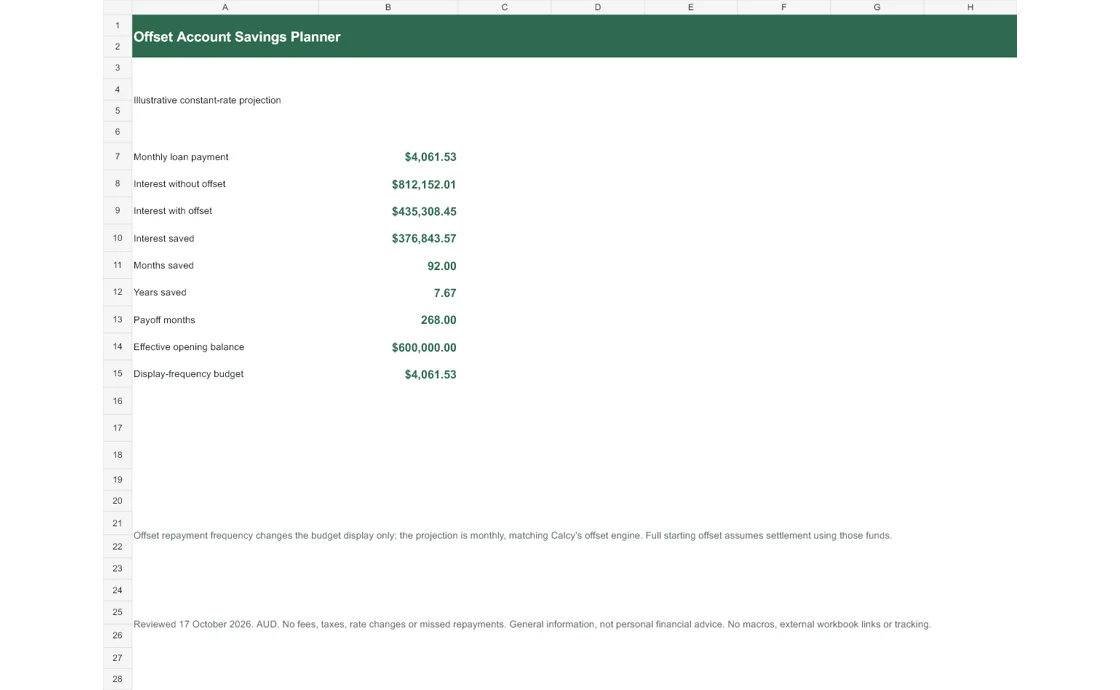
Enter the loan balance, annual rate, term, starting offset and monthly contribution. The Dashboard compares total interest without and with offset, interest saved, months and years saved, and the opening effective interest-bearing balance. The Comparison and Monthly Projection sheets show where the difference comes from.
The balance chart compares both paths over time. A separate repayment-frequency choice converts the monthly loan payment into a weekly or fortnightly budgeting equivalent. It does not change the monthly simulation or pretend to schedule daily offset transactions.
Who it helps
Use it when deciding whether keeping a sustained balance in an eligible offset account is worth investigating with your lender. It is especially useful for distinguishing cash held in offset from extra repayments directly reducing principal.
It assumes the account is correctly linked and gives a 100% offset. Not every home loan supports an offset and some accounts only offset a portion of the balance. Compare account fees and any rate premium separately; this workbook does not calculate a net product recommendation.
Worked example: a balance plus regular contributions
For an illustrative $650,000 loan at 6.39% over 30 years, the monthly loan payment is $4,061.53. Starting with $50,000 in offset and adding $500 after each monthly repayment gives approximately $435,308 total interest, compared with $812,152 without offset. Modelled interest saved is about $376,844 and time saved is 92 months.
This is an illustration, not a lender quote or forecast. The offset contributions remain separate from the mortgage repayment budget. No withdrawals are modelled. Changing either assumption can materially alter the projection.
Monthly methodology, not a daily bank statement
The workbook mirrors Calcy’s offset engine. Each month’s effective offset is the smaller of opening offset and opening loan. Interest is the remaining interest-bearing balance multiplied by annual rate / 12. The monthly loan payment stays unchanged and the interest reduction increases principal paid. Contributions enter offset after that payment.
ASIC Moneysmart explains that most home loans calculate interest daily. The monthly model is a simplification. Salary timing, withdrawals, lender day-count rules and daily balance changes are not represented. The workbook therefore labels all savings as illustrative estimates.
When the starting offset covers the loan
A fully offset loan is not automatically a closed loan. To match the existing Calcy engine’s boundary case, if the starting offset equals or exceeds the loan this workbook assumes using those funds to settle the loan in month one, leaving any surplus cash. That is a settlement assumption, not the ordinary operation of an offset account.
If you intend to retain all of the cash in offset while continuing repayments, do not interpret that boundary case as your payoff date. The distinction is stated on Offset Inputs and in Instructions. Obtain an actual payout figure and closure requirements from the lender.
Limits and practical checks
The rate stays constant; no fees, tax effects, withdrawals, redraws or partial offsets are included. Contributions are non-negative monthly amounts. Interest-bearing balances are capped at zero when offset is larger than the loan. Blank, text, negative or unsupported inputs leave outputs unavailable.
Save your own copy, edit the green cells and review the monthly balances. Compare the fee and interest-rate difference of an offset loan outside this model. Check that the account is actually linked and that your lender’s statements show the expected interest treatment.
Check the method and compare online
Read ASIC Moneysmart on paying off a mortgage faster and how mortgage offset accounts work. These explain the concepts; the workbook uses Calcy’s stated model assumptions.
Optional email updates
Get new Calcy tools and home-buying updates
Free calculators, spreadsheets and practical Australian home-buying resources. Unsubscribe anytime. Confirm your address by email before receiving updates. Downloading never signs you up.
Frequently asked questions
Is an offset account the same as an extra repayment?
No. Offset money sits in a separate linked account and reduces the balance on which interest is charged. An extra repayment reduces the loan principal.
Does the spreadsheet calculate daily interest?
No. It uses a monthly approximation matching Calcy’s offset model. Daily balances and lender rules can produce different savings.
What does the repayment frequency input do?
It converts the monthly payment into a budgeting equivalent only. It does not change the monthly offset projection.
Does a fully funded offset automatically repay my loan?
No. The model’s starting-full-offset boundary assumes using the money to settle in month one. Holding the money in offset alone does not close the loan.
General information and estimates, not personal financial advice. Check assumptions and official sources before making decisions.